Zimperium MTD - Threats
Overview
Zimperium Mobile Threat Defense (MTD) is an AI-powered security solution that provides real-time, on-device protection for iOS, Android, and ChromeOS devices. Using machine learning, it detects and remediates advanced threats across four key vectors : device, network, phishing, and applications, even when the device is offline. Designed for the enterprise, it secures both corporate and BYOD endpoints without compromising user privacy or battery life.
Warning
Important note - This format is currently in beta. We highly value your feedback to improve its performance.
- Vendor: Zimperium
- Detection based on: Telemetry
- Supported application or feature: Threats
Configure
Create API keys
-
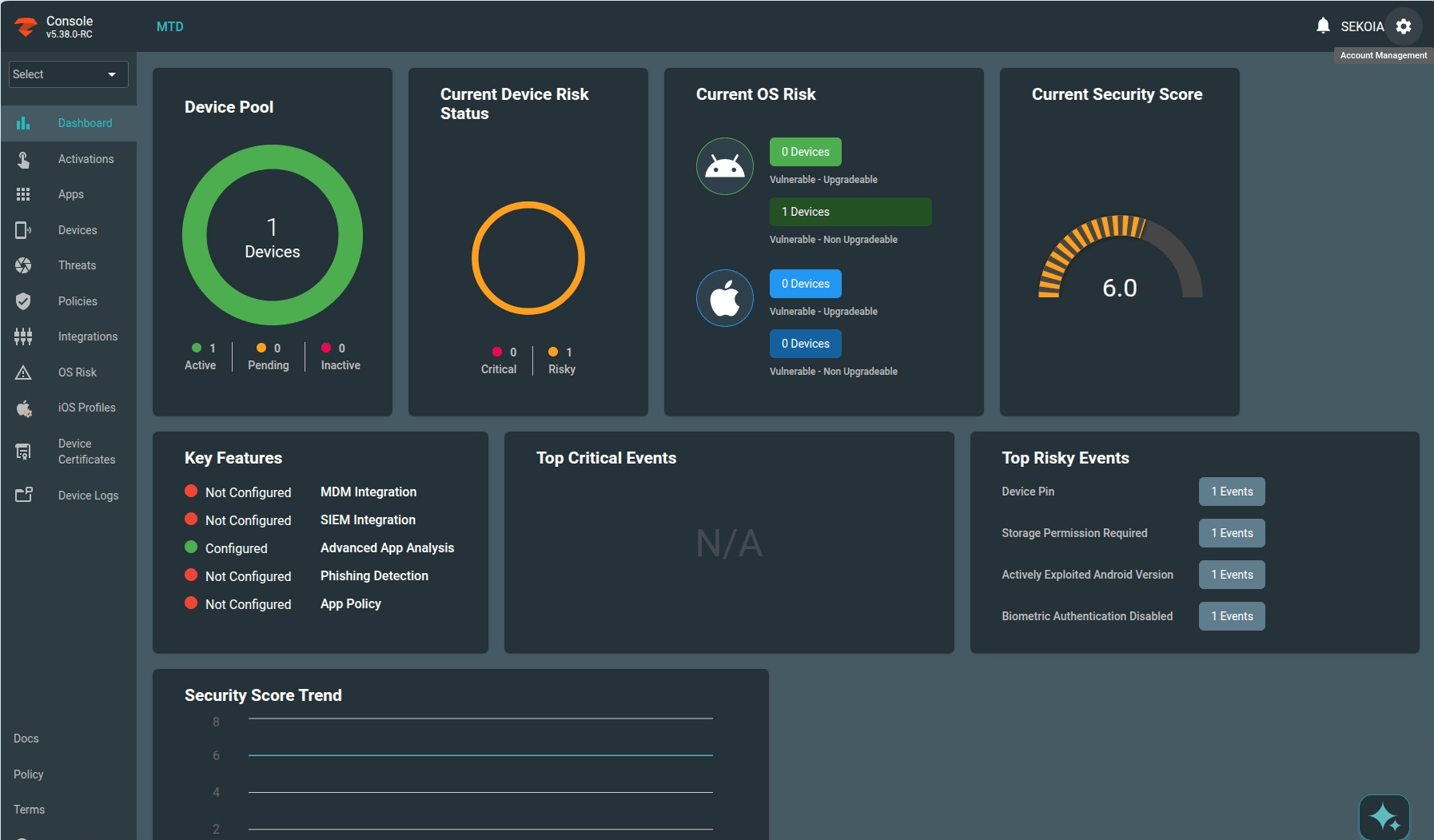
Click on the wheel in the upper right corner of your Zimperium console
-
Go to
Authorizations, click on the+ Generate API keyin the top right corner. -
Choose
MTDtab and checkViewinThreatsgroup.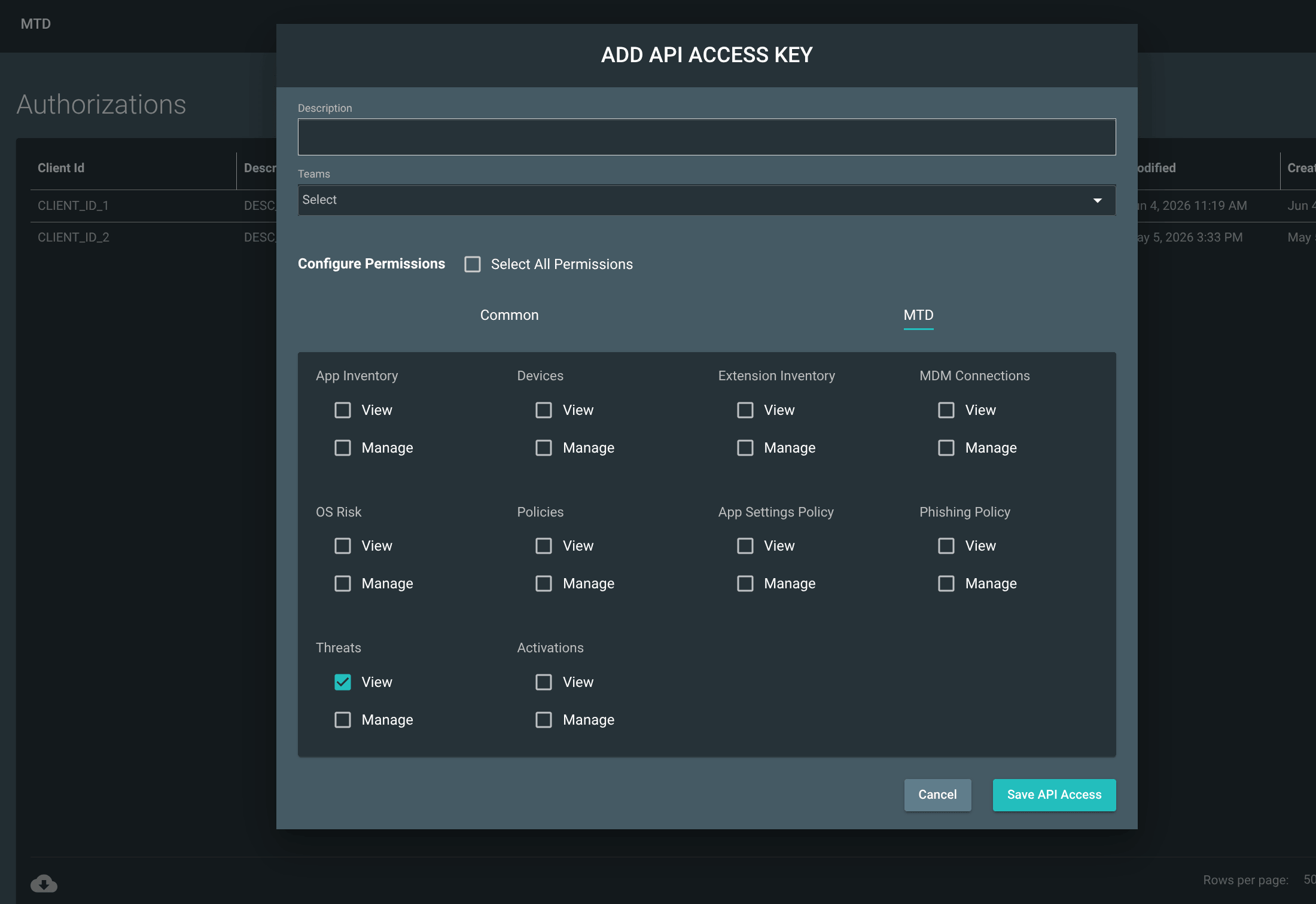
-
Be careful to save your secret key, as it will not be displayed again. However, you could always generate a new one here.
Create an Intake
- Navigate to the Intake page in Sekoia.io.
- Click Create Intake and select Zimperium Mobile Threat Defense from the dropdown.
- Set up the intake configuration with client id and client secret acquired in the previous step.
Raw Events Samples
In this section, you will find examples of raw logs as generated natively by the source. These examples are provided to help integrators understand the data format before ingestion into Sekoia.io. It is crucial for setting up the correct parsing stages and ensuring that all relevant information is captured.
{
    "id": "11111111-1111-1111-1111-111111111111",
    "accountId": "ANONYMIZED",
    "teamId": "22222222-2222-2222-2222-222222222222",
    "teamName": "Default",
    "zappInstanceId": "bbbbbbbb-bbbb-bbbb-bbbb-bbbbbbbbbbbb",
    "deviceId": "33333333-3333-3333-3333-333333333333",
    "device": {
        "id": "33333333-3333-3333-3333-333333333333",
        "mdmDeviceId": "",
        "mamDeviceId": "",
        "model": "REDACTED",
        "os": {
            "id": 1,
            "name": "ANDROID",
            "version": "16"
        },
        "zdeviceId": "cccccccc-cccc-cccc-cccc-cccccccccccc"
    },
    "os": "android",
    "zappId": "44444444-4444-4444-4444-444444444444",
    "groupId": "dddddddd-dddd-dddd-dddd-dddddddddddd",
    "timestamp": 1773830431000,
    "timestampInfo": {
        "timestamp": 1773830431000,
        "toTheSecond": 1773830431000,
        "toTheMinute": 1773830400000,
        "toTheHour": 1773828000000,
        "toTheDay": 1773792000000
    },
    "eventReceivedTimestamp": 1773830433130,
    "eventProcessedTimestamp": 1773830433143,
    "timeTravel": "NONE",
    "threatTypeId": 172,
    "threatTypeName": "ACTIVE EXPLOIT OS ANDROID",
    "severity": 2,
    "severityName": "ELEVATED",
    "vector": 2,
    "vectorName": "Device",
    "categoryId": 64,
    "classification": 2,
    "classificationName": "RISKY",
    "state": 1,
    "responses": [
        {
            "responseId": 0,
            "eventId": "55555555-5555-5555-5555-555555555555",
            "timestamp": 1773830431000
        }
    ],
    "mitigationEvents": [],
    "generalInfo": {
        "timeInterval": 2,
        "deviceIp": "1.2.3.4",
        "externalIp": "10.20.30.40",
        "ssid": "",
        "bssid": "02:00:00:00:00:00",
        "actionTriggered": "Alert User",
        "deviceTimestamp": 1773830431000,
        "androidEnterpriseManagementState": {
            "ownership": "PERSONALLY_OWNED",
            "managementMode": "UNMANAGED",
            "managementAppPackageName": "",
            "workProfileState": "WORK_PROFILE_NOT_PRESENT"
        },
        "androidEnterpriseAccessNetworkState": [
            {
                "networkTransport": "[\"WIFI\"]",
                "wifiSecurityLevel": "PERSONAL",
                "privateDnsState": "ACTIVE"
            }
        ]
    },
    "locationInfo": {
        "geoPoint": {
            "lat": 20.0,
            "lon": 20.0
        },
        "source": "GEOIP",
        "city": "Redacted",
        "country": "France"
    },
    "suspiciousUrlInfo": {},
    "arpTablesInfo": {
        "before": []
    },
    "runningServices": [],
    "networkStatistics": [],
    "nearByNetworks": [],
    "processList": [
        {
            "service": "n/a",
            "user": "10286",
            "processId": "9938",
            "parentProcessId": "1474",
            "processName": ".zimperium.zips"
        }
    ],
    "simulated": false,
    "lastModified": 1773830431000,
    "detectionFiles": [],
    "activationName": "john.doe@company.com",
    "agentType": 2,
    "deviceOwner": "john.doe@company.com",
    "policiesInfo": [
        {
            "type": "App Policy Android v2",
            "hash": "64351b6847c6925629977111ffad0afd",
            "deployedAt": 1773767334000,
            "downloadedAt": 1773830428000
        },
        {
            "type": "App Settings",
            "hash": "6f09229e2298bbb9aea532783e5fb292",
            "deployedAt": 1773767334000,
            "downloadedAt": 1773830428000
        },
        {
            "type": "Network Policy",
            "hash": "ddd40425296c539823863221adda7c4a",
            "deployedAt": 1773767334000,
            "downloadedAt": 1773830428000
        },
        {
            "type": "OS Risk",
            "hash": "331f6baad5f6a48a0038800da9480592",
            "deployedAt": 1773767334000,
            "downloadedAt": 1773830428000
        },
        {
            "type": "Phishing",
            "hash": "9ef362e0c1be90c4067928c8ca3148f4",
            "deployedAt": 1773767334000,
            "downloadedAt": 1773830428000
        },
        {
            "type": "Privacy",
            "hash": "55386c63025ffe18b01edac0cf95d116",
            "deployedAt": 1773781889000,
            "downloadedAt": 1773830428000
        },
        {
            "type": "Threat Android",
            "hash": "26e9ec7025d157aa74ed714c9a285309",
            "deployedAt": 1773781843000,
            "downloadedAt": 1773830428000
        }
    ],
    "triggeredActions": [
        {
            "actionType": 0,
            "actionTypeName": "ALERT_USER",
            "actionMetadata": null
        }
    ],
    "zeventId": "eeeeeeee-eeee-eeee-eeee-eeeeeeeeeeee",
    "zappInstance": {
        "id": "bbbbbbbb-bbbb-bbbb-bbbb-bbbbbbbbbbbb",
        "name": "MTD",
        "bundleId": "com.zimperium.zips",
        "version": "5.9.22",
        "buildNumber": "0.260116182",
        "zversion": "5.9.22",
        "zbuildNumber": "26011618"
    }
}
Detection section
The following section provides information for those who wish to learn more about the detection capabilities enabled by collecting this intake. It includes details about the built-in rule catalog, event categories, and ECS fields extracted from raw events. This is essential for users aiming to create custom detection rules, perform hunting activities, or pivot in the events page.
Related Built-in Rules
The following Sekoia.io built-in rules match the intake Zimperium Mobile Threat Defense. This documentation is updated automatically and is based solely on the fields used by the intake which are checked against our rules. This means that some rules will be listed but might not be relevant with the intake.
SEKOIA.IO x Zimperium Mobile Threat Defense on ATT&CK Navigator
Active Directory Data Export Using Csvde
Detects the use of Csvde, a command-line tool from Windows Server that can be used to export Active Directory data to CSV files. This export doesn't include password hashes, but can be used as a discovery tool to enumerate users, machines and group memberships.
- Effort: elementary
AdFind Usage
Detects the usage of the AdFind tool. AdFind.exe is a free tool that extracts information from Active Directory. Wizard Spider (Bazar, TrickBot, Ryuk), FIN6 and MAZE operators have used AdFind.exe to collect information about Active Directory organizational units and trust objects
- Effort: elementary
Adexplorer Usage
Detects the usage of Adexplorer, a legitimate tool from the Sysinternals suite that could be abused by attackers as it can saves snapshots of the Active Directory Database.
- Effort: advanced
Advanced IP Scanner
Detects the use of Advanced IP Scanner. Seems to be a popular tool for ransomware groups.
- Effort: master
Bloodhound and Sharphound Tools Usage
Detects default process names and default command line parameters used by Bloodhound and Sharphound tools.
- Effort: intermediate
Certificate Authority Modification
Installation of new certificate(s) in the Certificate Authority can be used to trick user when spoofing website or to add trusted destinations.
- Effort: master
Certify Or Certipy
Detects the use of certify and certipy which are two different tools used to enumerate and abuse Active Directory Certificate Services.
- Effort: advanced
Cobalt Strike Default Beacons Names
Detects the default names of Cobalt Strike beacons / payloads.
- Effort: intermediate
Cryptomining
Detection of domain names potentially related to cryptomining activities.
- Effort: master
DNS Query For Iplookup
Detects dns query of observables tagged as iplookup.
- Effort: master
Dynamic DNS Contacted
Detect communication with dynamic dns domain. This kind of domain is often used by attackers. This rule can trigger false positive in non-controlled environment because dynamic dns is not always malicious.
- Effort: master
Enable Root Account With Dsenableroot
Detects when root is enabled. Attackers can use this as a mean of persistence since root is disabled by default.
- Effort: elementary
Exfiltration And Tunneling Tools Execution
Execution of well known tools for data exfiltration and tunneling
- Effort: advanced
Exfiltration Domain
Detects traffic toward a domain flagged as a possible exfiltration vector.
- Effort: master
HackTools Suspicious Names
Quick-win rule to detect the default process names or file names of several HackTools.
- Effort: advanced
Kernel Module Alteration
Kernel module installation can be used to configure system settings to automatically execute a program during system boot or logon to maintain persistence or gain higher-level privileges on compromised systems. The prerequisites are to enable monitoring of the finit_module, init_module, delete_module syscalls using Auditbeat.
- Effort: advanced
Network Scanning and Discovery
Tools and command lines used for network discovery from current system
- Effort: advanced
Network Sniffing
List of common tools used for network packages sniffing
- Effort: advanced
Network Sniffing Windows
Network sniffing refers to using the network interface on a system to monitor or capture information sent over a wired or wireless connection. An adversary may place a network interface into promiscuous mode to passively access data in transit over the network, or use span ports to capture a larger amount of data.
- Effort: intermediate
NlTest Usage
Detects attempts to gather information on domain trust relationships that may be used to identify lateral movement opportunities. These command lines were observed in numerous attacks, but also sometimes from legitimate administrators for debugging purposes. The rule does not cover very basics commands but rather the ones that are interesting for attackers to gather information on a domain.
- Effort: advanced
PasswordDump SecurityXploded Tool
Detects the execution of the PasswordDump SecurityXploded Tool
- Effort: elementary
PsExec Process
Detects PsExec execution, command line which contains pstools or installation of the PsExec service. PsExec is a SysInternals which can be used to execute a program on another computer. The tool is as much used by attackers as by administrators.
- Effort: advanced
RDP Session Discovery
Detects use of RDP session discovery via qwinsta or quser. Used by some threat actors to know if someone is working via RDP on a server.
- Effort: advanced
RTLO Character
Detects RTLO (Right-To-Left character) in file and process names.
- Effort: elementary
Remote Access Tool Domain
Detects traffic toward a domain flagged as a Remote Administration Tool (RAT).
- Effort: master
Remote Monitoring and Management Software - AnyDesk
Detect artifacts related to the installation or execution of the Remote Monitoring and Management tool AnyDesk.
- Effort: master
Remote Monitoring and Management Software - Atera
Detect artifacts related to the installation or execution of the Remote Monitoring and Management tool Atera.
- Effort: master
SEKOIA.IO Intelligence Feed
Detect threats based on indicators of compromise (IOCs) collected by SEKOIA's Threat and Detection Research team.
- Effort: elementary
Sekoia.io EICAR Detection
Detects observables in Sekoia.io CTI tagged as EICAR, which are fake samples meant to test detection.
- Effort: master
Suspicious Double Extension
Detects suspicious use of an .exe extension after a non-executable file extension like .pdf.exe, a set of spaces or underlines to cloak the executable file in spearphishing campaigns
- Effort: advanced
System Info Discovery
System info discovery, attempt to detects basic command use to fingerprint a host.
- Effort: master
TOR Usage Generic Rule
Detects TOR usage globally, whether the IP is a destination or source. TOR is short for The Onion Router, and it gets its name from how it works. TOR intercepts the network traffic from one or more apps on user’s computer, usually the user web browser, and shuffles it through a number of randomly-chosen computers before passing it on to its destination. This disguises user location, and makes it harder for servers to pick him/her out on repeat visits, or to tie together separate visits to different sites, this making tracking and surveillance more difficult. Before a network packet starts its journey, user’s computer chooses a random list of relays and repeatedly encrypts the data in multiple layers, like an onion. Each relay knows only enough to strip off the outermost layer of encryption, before passing what’s left on to the next relay in the list.
- Effort: master
Event Categories
The following table lists the data source offered by this integration.
| Data Source | Description |
|---|---|
Application logs |
None |
In details, the following table denotes the type of events produced by this integration.
| Name | Values |
|---|---|
| Kind | `` |
| Category | intrusion_detection |
| Type | info |
Transformed Events Samples after Ingestion
This section demonstrates how the raw logs will be transformed by our parsers. It shows the extracted fields that will be available for use in the built-in detection rules and hunting activities in the events page. Understanding these transformations is essential for analysts to create effective detection mechanisms with custom detection rules and to leverage the full potential of the collected data.
{
    "message": "{\"id\": \"11111111-1111-1111-1111-111111111111\", \"accountId\": \"ANONYMIZED\", \"teamId\": \"22222222-2222-2222-2222-222222222222\", \"teamName\": \"Default\", \"zappInstanceId\": \"bbbbbbbb-bbbb-bbbb-bbbb-bbbbbbbbbbbb\", \"deviceId\": \"33333333-3333-3333-3333-333333333333\", \"device\": {\"id\": \"33333333-3333-3333-3333-333333333333\", \"mdmDeviceId\": \"\", \"mamDeviceId\": \"\", \"model\": \"REDACTED\", \"os\": {\"id\": 1, \"name\": \"ANDROID\", \"version\": \"16\"}, \"zdeviceId\": \"cccccccc-cccc-cccc-cccc-cccccccccccc\"}, \"os\": \"android\", \"zappId\": \"44444444-4444-4444-4444-444444444444\", \"groupId\": \"dddddddd-dddd-dddd-dddd-dddddddddddd\", \"timestamp\": 1773830431000, \"timestampInfo\": {\"timestamp\": 1773830431000, \"toTheSecond\": 1773830431000, \"toTheMinute\": 1773830400000, \"toTheHour\": 1773828000000, \"toTheDay\": 1773792000000}, \"eventReceivedTimestamp\": 1773830433130, \"eventProcessedTimestamp\": 1773830433143, \"timeTravel\": \"NONE\", \"threatTypeId\": 172, \"threatTypeName\": \"ACTIVE EXPLOIT OS ANDROID\", \"severity\": 2, \"severityName\": \"ELEVATED\", \"vector\": 2, \"vectorName\": \"Device\", \"categoryId\": 64, \"classification\": 2, \"classificationName\": \"RISKY\", \"state\": 1, \"responses\": [{\"responseId\": 0, \"eventId\": \"55555555-5555-5555-5555-555555555555\", \"timestamp\": 1773830431000}], \"mitigationEvents\": [], \"generalInfo\": {\"timeInterval\": 2, \"deviceIp\": \"1.2.3.4\", \"externalIp\": \"10.20.30.40\", \"ssid\": \"\", \"bssid\": \"02:00:00:00:00:00\", \"actionTriggered\": \"Alert User\", \"deviceTimestamp\": 1773830431000, \"androidEnterpriseManagementState\": {\"ownership\": \"PERSONALLY_OWNED\", \"managementMode\": \"UNMANAGED\", \"managementAppPackageName\": \"\", \"workProfileState\": \"WORK_PROFILE_NOT_PRESENT\"}, \"androidEnterpriseAccessNetworkState\": [{\"networkTransport\": \"[\\\"WIFI\\\"]\", \"wifiSecurityLevel\": \"PERSONAL\", \"privateDnsState\": \"ACTIVE\"}]}, \"locationInfo\": {\"geoPoint\": {\"lat\": 20.0, \"lon\": 20.0}, \"source\": \"GEOIP\", \"city\": \"Redacted\", \"country\": \"France\"}, \"suspiciousUrlInfo\": {}, \"arpTablesInfo\": {\"before\": []}, \"runningServices\": [], \"networkStatistics\": [], \"nearByNetworks\": [], \"processList\": [{\"service\": \"n/a\", \"user\": \"10286\", \"processId\": \"9938\", \"parentProcessId\": \"1474\", \"processName\": \".zimperium.zips\"}], \"simulated\": false, \"lastModified\": 1773830431000, \"detectionFiles\": [], \"activationName\": \"john.doe@company.com\", \"agentType\": 2, \"deviceOwner\": \"john.doe@company.com\", \"policiesInfo\": [{\"type\": \"App Policy Android v2\", \"hash\": \"64351b6847c6925629977111ffad0afd\", \"deployedAt\": 1773767334000, \"downloadedAt\": 1773830428000}, {\"type\": \"App Settings\", \"hash\": \"6f09229e2298bbb9aea532783e5fb292\", \"deployedAt\": 1773767334000, \"downloadedAt\": 1773830428000}, {\"type\": \"Network Policy\", \"hash\": \"ddd40425296c539823863221adda7c4a\", \"deployedAt\": 1773767334000, \"downloadedAt\": 1773830428000}, {\"type\": \"OS Risk\", \"hash\": \"331f6baad5f6a48a0038800da9480592\", \"deployedAt\": 1773767334000, \"downloadedAt\": 1773830428000}, {\"type\": \"Phishing\", \"hash\": \"9ef362e0c1be90c4067928c8ca3148f4\", \"deployedAt\": 1773767334000, \"downloadedAt\": 1773830428000}, {\"type\": \"Privacy\", \"hash\": \"55386c63025ffe18b01edac0cf95d116\", \"deployedAt\": 1773781889000, \"downloadedAt\": 1773830428000}, {\"type\": \"Threat Android\", \"hash\": \"26e9ec7025d157aa74ed714c9a285309\", \"deployedAt\": 1773781843000, \"downloadedAt\": 1773830428000}], \"triggeredActions\": [{\"actionType\": 0, \"actionTypeName\": \"ALERT_USER\", \"actionMetadata\": null}], \"zeventId\": \"eeeeeeee-eeee-eeee-eeee-eeeeeeeeeeee\", \"zappInstance\": {\"id\": \"bbbbbbbb-bbbb-bbbb-bbbb-bbbbbbbbbbbb\", \"name\": \"MTD\", \"bundleId\": \"com.zimperium.zips\", \"version\": \"5.9.22\", \"buildNumber\": \"0.260116182\", \"zversion\": \"5.9.22\", \"zbuildNumber\": \"26011618\"}}",
    "event": {
        "action": "Alert User",
        "category": [
            "intrusion_detection"
        ],
        "severity": 2,
        "type": [
            "info"
        ]
    },
    "@timestamp": "2026-03-18T10:40:31Z",
    "device": {
        "id": "33333333-3333-3333-3333-333333333333",
        "model": {
            "name": "REDACTED"
        }
    },
    "group": {
        "id": "22222222-2222-2222-2222-222222222222",
        "name": "Default"
    },
    "host": {
        "os": {
            "platform": "ANDROID",
            "type": "android",
            "version": "16"
        }
    },
    "observer": {
        "product": "Mobile Threat Defense",
        "type": "sensor",
        "vendor": "Zimperium"
    },
    "organization": {
        "id": "ANONYMIZED"
    },
    "process": {
        "name": ".zimperium.zips",
        "parent": {
            "pid": 1474
        },
        "pid": 9938
    },
    "related": {
        "ip": [
            "1.2.3.4",
            "10.20.30.40"
        ]
    },
    "rule": {
        "id": "172",
        "name": "ACTIVE EXPLOIT OS ANDROID"
    },
    "source": {
        "address": "1.2.3.4",
        "geo": {
            "city_name": "Redacted",
            "country_name": "France",
            "location": {
                "lat": 20.0,
                "lon": 20.0
            }
        },
        "ip": "1.2.3.4",
        "mac": "02:00:00:00:00:00",
        "nat": {
            "ip": "10.20.30.40"
        }
    },
    "user": {
        "email": "john.doe@company.com"
    },
    "zimperium": {
        "mtd": {
            "category_id": 64,
            "classification": {
                "id": 2,
                "name": "RISKY"
            },
            "event_id": "11111111-1111-1111-1111-111111111111",
            "group_id": "dddddddd-dddd-dddd-dddd-dddddddddddd",
            "vector": {
                "id": 2,
                "name": "Device"
            }
        }
    }
}
Extracted Fields
The following table lists the fields that are extracted, normalized under the ECS format, analyzed and indexed by the parser. It should be noted that infered fields are not listed.
| Name | Type | Description |
|---|---|---|
@timestamp |
date |
Date/time when the event originated. |
event.action |
keyword |
The action captured by the event. |
event.category |
keyword |
Event category. The second categorization field in the hierarchy. |
event.severity |
long |
Numeric severity of the event. |
event.type |
keyword |
Event type. The third categorization field in the hierarchy. |
group.id |
keyword |
Unique identifier for the group on the system/platform. |
group.name |
keyword |
Name of the group. |
host.os.platform |
keyword |
Operating system platform (such centos, ubuntu, windows). |
host.os.type |
keyword |
Which commercial OS family (one of: linux, macos, unix or windows). |
host.os.version |
keyword |
Operating system version as a raw string. |
observer.product |
keyword |
The product name of the observer. |
observer.type |
keyword |
The type of the observer the data is coming from. |
observer.vendor |
keyword |
Vendor name of the observer. |
organization.id |
keyword |
Unique identifier for the organization. |
process.name |
keyword |
Process name. |
process.parent.pid |
long |
Process id. |
process.pid |
long |
Process id. |
rule.id |
keyword |
Rule ID |
rule.name |
keyword |
Rule name |
source.geo.city_name |
keyword |
City name. |
source.geo.country_name |
keyword |
Country name. |
source.geo.location |
geo_point |
Longitude and latitude. |
source.ip |
ip |
IP address of the source. |
source.mac |
keyword |
MAC address of the source. |
source.nat.ip |
ip |
Source NAT ip |
user.email |
keyword |
User email address. |
user.name |
keyword |
Short name or login of the user. |
zimperium.mtd.category_id |
long |
|
zimperium.mtd.classification.id |
long |
|
zimperium.mtd.classification.name |
keyword |
|
zimperium.mtd.event_id |
keyword |
|
zimperium.mtd.group_id |
keyword |
|
zimperium.mtd.processes |
array |
|
zimperium.mtd.vector.id |
long |
|
zimperium.mtd.vector.name |
keyword |
For more information on the Intake Format, please find the code of the Parser, Smart Descriptions, and Supported Events here.